Dressing the Dress Form

April 22nd, 2013 by chocolatetrudi No comments »

Most of the tutorials for padding a dress form that I found advocate using non-stretch fabric and a paper pattern for the purpose, adjusted to fit your body, that you stuff with filling then spray with water to get it to shrink a bit. Since that’s the sort of fiddly nightmare I bought a dress form to avoid, I’m going to try something else.

In one of the tutorials for the above method the stuffing was done by applying layers of thin batting until the form matches your shape. I figured if did this first I could put a ‘sock’ of stretch fabric on top, pinched in at the sides until it fits snugly.

I started by measuring myself all over again. It was rather dismaying to find I’d put on a bit of weight since I bought the form. I also hadn’t got the body length quite right. I had to crank it out to the maximum – double what you saw in the previous photo.

The trouble with adjustable dress forms is the more you expand them the more gaps there are that you can’t pin to. And they feel a lot less stable. The trouble with most brands is that the next size up starts at 16, so I had to buy the smaller and crank it way open. To combat these problems I decided it would be better to set the form a little smaller than me and pad out more, to counteract this.

So I started applying layers of batting. I traced the cup of an old bra first then cut smaller and smaller pieces to get a smooth shape. I filled in the waist and padded out the hips, then sewed it all together so it wouldn’t fall off in the next stage:

I put the bra on again and decided to leave it there so it would hold the bust padding in place and indicate where bra straps are likely to be. (As you can see, the bust needed a lot more padding. I’d read an 8 on my sheet of measurements as a 3.)

Which was to baste some fleece into a tube and carefully slip it over the form. I then pinched, pinned and basted it together at the sides and up over the shoulders to the neck:

On it went again for some tweaking. Measurements were checked yet again. Once I was sure it was fitting well I overlocked the seams. Here it the sock back on the form:

And with lines:

I was pretty happy with the result. There are a few tweaks I want to make, though. I need to work out how to fix the bottom of the sock in place. I also want to do a silhouette test – take a photo of the form and me next to each other, from the side and front, to see if the padding is in the right place. While the form is the same measurement as me, I suspect there’s padding in the the small of the back that ought to be at the belly.

And the front and back pieces of the form appear to be overlapping at the shoulders, pulled in by the sock. I need to find a way to stop that happening or all my garments will be small at the shoulder and around the armholes.

Re-lining Retro

April 19th, 2013 by chocolatetrudi 1 comment »

A few weeks ago Paul took me into a shop on Swanston Street in Melbourne that I had no idea existed, and almost wish I didn’t: Retrostar Vintage. It’s huge, apparently ‘the largest vintage clothing store in Australia’.

I tried on a few things, including a velvet jacket since I’d seen on Pinterest that velvet was making a comeback and I’ve always liked a bit of velvety elegance. It was one of the fashions of the 90s I really loved. The jacket fit perfectly so I bought it:

I have to say, though. The 90s are ‘retro’. They’re not long enough ago to qualify as ‘vintage’. I’m not THAT old.

The jacket had one big down side: the lining was literally falling apart. I decided I’d have it re-lined. I chose a beautiful royal blue satin in my much-culled fabric stash.

After making the two costumes I felt a bit bolder in my sewing ambitions, so I decided to try lining it myself. I removed the old lining – which more a matter of cutting around the seams than unpicking as it had deteriorated so much it was practically evaporating before my eyes. I used it to make a pattern:

Then I noticed something a bit strange about the pockets:

One was a bit distorted, so I removed them both. After washing and brushing the coat, the old seam indentation lines on the jacket aren’t too obvious. They look like seam lines that are meant to be there. I’ve decided to leave the pockets off.

I cut out the new lining pieces:

Sewed them together:

Sewed the lining onto the jacked at the bottom and sides, then hand stitched the collar and wrists. The hand stitching was much easier done on the old dress form:

And got Paul to take the usual headless model shots:

New lining!

Formative Steps

April 16th, 2013 by chocolatetrudi No comments »

The time has come to retire my old duct tape* dress form. Why? Well, here’s a pic when she was new and one as she is now:

And a view of the base:

She spent a lot of time in my workroom during baking hot summer days and, really, anyone would sag in those conditions. I could re-stuff her and add some internal supports, but in the last few years my shape has changed, too. Particularly in the frontal region.

Making and using her has been really worthwhile. It’s shown me that I enjoy sewing better when working on a dress form. I enjoy pinching and pinning and getting an immediate idea of what the effect will be. It’s particularly useful when refashioning. I like designing a lot more than the actual sewing, but I don’t mind the sewing so much when I actually get a piece of clothing out of it that fits and looks good. Using a form means that happen more often than it used to.

So I decided it was worth spending some money and getting a ‘proper’ dress form. After some hunting around the internet for dress form reviews and recommendation, and some ringing around to see which shops stocked which forms, I settled on a Semco, which I bought at Spotlight:

This was the only model I found, on the internet or in shops, with a body length adjustment and at a reasonable price. Since I am long in the body I knew I’d need that feature. How long? One to two finger widths:

The next step is to make the form match my proportions. That means padding and a cover, because these sorts of forms are a very standard shape. (Pity they don’t have a bust line lowering adjustment, for us over-40s women.)

What will happen to the duct tape form? I’m tempted to keep her to display things on, but she’s a bit of an ugly duckling and I don’t have room for two forms. It might also help to cut her in half and use her as a kind of temporary mould to get the new form closer to my real shape.

-

*Did you know that ‘duck’ tape was in use long before ‘duct’ tape? I assumed ‘duck’ came about because of people miss-hearing ‘duct’. Turns out the tape was originally strips of duck cloth. Later it was used to seal ducts. To confuse things, the company who made duct tape called it ‘Duck Tape’, with a little duck character on the label.

Blog Lovin’

April 13th, 2013 by chocolatetrudi 2 comments »

Following crafty blogs has never got old for me. I get so much inspiration from reading about other crafty people’s projects and lives. It took me a long while to work out what an RSS feed was, however. I think I did when I got a Mac and discovered that if I bookmarked the feed of a blog in Safari a handy little number would appear beside the bookmark if there was a new post to see.

So I was rather annoyed when the feature disappeared from Safari when I upgraded the operating system. Sure, you could now put your feeds in Mail, but the corresponding Mail app on the iPhone and iPad didn’t have that feature so I could no longer snatch bits of time here and there catch up on blogs.

I looked into sites and apps but they all seemed to involve signing up to Google. Not that I was avoiding Google, it’s just that since they took over Yahoo it seems a different combination of my yahoo/google username and password work each time I try to sign in, and now I avoid having to sign in at all. Yeah, I know that’s pathetic, but I’ve never had anything important enough to do to force me to sort it out.

When I heard Google Reader was on the way out I was glad I hadn’t wasted my time. People began recommending other RSS feed apps and sites, but it seemed they all required my Google username and password or else a Facebook login. (I also don’t do Facebook.) That was, until one of the bloggers I follow, over at Kootoyoo, posted that she was switching to Bloglovin’ as it didn’t use Google Reader. I checked it out and it didn’t use Facebook login’s either. And there’s an iPhone app. Sweet!

So I’ve signed up to Bloglovin’ and I’m lovin’ it. The interface is clear and you can separate blogs into categories. The iPhone app works fine for catching up on blogs during morning tea or tv ad breaks. I’ve ‘claimed’ my blog on the site, too, so it’s easy to find. Or you could just click on the link in the sidebar.

Gift Yarn Jacket, Part II

April 10th, 2013 by chocolatetrudi 1 comment »

It’s finished! And I like it!

To recap: I had knit a long striped band out of some gift yarn and decided to make it the sleeve-yoke section of a jacket inspired by Jo Sharp’s Origami Bolero pattern. Though the Bendigo Luxury yarn (shade ‘bark’) I ordered to make the rest of the jacket arrived in a few days, by then I’d become thoroughly distracted by other machine knitting projects. It did benefit from a bit of time out, though. When I came to knit the body and collar/waistband I had a better idea of what I wanted to do.

First I knit the body on the Bond and blocked it to size. I had planned to make the collar/waistband piece out of some natural Bendigo yarn I already had, but by calculating the weight and number of stitches of the body piece I worked out that I didn’t have enough. There was almost enough left of the ‘bark’ coloured yarn, however, and I liked the idea of continuing with that shade. Having the rest of the garment in one solid colour would make the sleeves the feature. And a white band around the waist was only going to make that bit of me look bigger.

Trouble was, the Bond wasn’t wide enough (then) to knit the waistband, so I’d have to do it sideways, in a strip. That would make it very hard to get the size exactly right and use up all of the yarn. So I decided I’d just have to hand knit it, veeery slooowly. That’s why one of the first projects I started on the Bond is the last to be completed.

The Jo Sharp pattern is for a garment that can be worn both ways. Now that it’s done I’m not sure what I like better – the ribbed part at the waist or as a collar. Hmm. What do you think?

First Bond Fair Isle

April 7th, 2013 by chocolatetrudi 2 comments »

A couple of weeks ago I ordered a pair of garter bars for the Bond made by Kriskrafter:

They arrived just after I packed the Bond away to clear the dining table for some visitors, so I figured trying them out would have to wait until the next time I had a project to make.

While on the train on the way home from picking up the freebie machine I read the old manuals and realised that the way you do fair isle is really quite easy. I hadn’t got that far in the book for the machine I’d bought, because at the beginning there was already so much to learn.

Having taken over the dining table again so I could look over the freebie Bond and combine it with the one I’d bought, I figured I may as well try a small fair isle project – and give the garter bar a go too. Though not for making garter stitch but to do spaced decreases across the bed.

So I picked some yarn and a simple beanie pattern from the Bond manual, and got knitting.

I tried a simple zig zag as I could do that without worrying about a chart. The fair isle was pretty straight forward, though I had to learn by trial and error that whichever yarn has the greater number of stitches in a row has to be the one you knit with the carriage. When hand knitting fair isle I tend to make the floats a little tight. On the machine I’ve made them too loose, but now that I know I can adjust for that.

The garter bar worked well. Getting it to line up with all the needles takes a bit of fiddling, but it makes decreasing (and increasing) across a row so much faster and easier than doing it by hand.

Now that I’ve done a hat, I really want to make something larger. I have enough of the blue and brown yarns left to make a vest. Hmm…

(But that did have to wait. I had sewing to do. Lots of sewing.)

And Carrying On From There…

April 3rd, 2013 by chocolatetrudi No comments »

(If you’re a bit bored with Bond posts, don’t worry. As so often happens, I have posts about one craft lined up to publish while I’ve actually moved on to another – this time sewing up costumes. I don’t want to blog about one of the costumes until after the event, but the other should be good blog material… pun not intended. In the meantime…)

The new (design-wise) Bond came in this box:

The old came in a long, slim box, since it didn’t split in two like the newer style machines. (You can see the box in a photo below.) Obviously I wasn’t going to get the old bed into the new bed’s box. I could get the two connected pieces of the new style one into the old box – just – but there was no room for the carriages and all the bits and pieces.

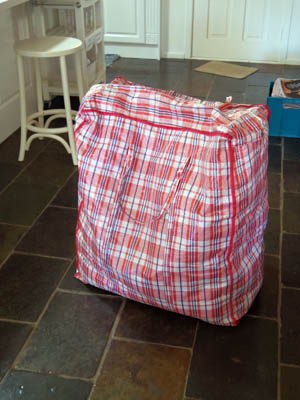
I needed a carry case of some sort, so I went to eBay and searched through the categories. I found a camera bag that might have worked if it had been longer, and a tool bag with the same problem. I found bags for cricket bats, but they were too flimsy. Finally I looked in the musical instrument section and found keyboard carriers.

$50 (including postage) later I had this:

It’s exactly the width of the old Bond’s box:

It’s padded but not rigid, so I’m using the old Bond box to protect the beds. I had put all the tools and such in separate zip lock bags then into another cardboard box, but the bags are fiddly to get into while you’re working. So I measured up the remaining space in the keyboard bag and shopped around until I found this toolbox:

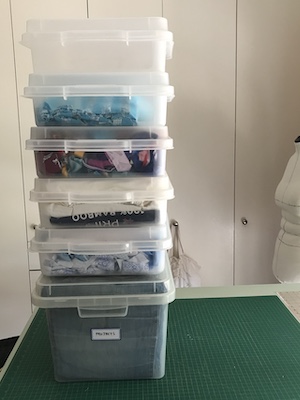
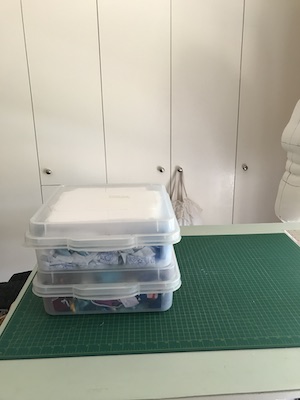
And Paul discovered that the carriages fit perfectly into those plastic shoe storage boxes with room for the keyplates as well:

Now that I’ve finished incorporating the new old Bond with the old new Bond, and got everything to fit nicely into one convenient carry bag… someone has offered to give me another Bond. And that has given me another crazy Bond modification idea…

Could I rig up a second bed in front, and do circular knitting?

Okay, the New Stuff is Good Too

March 31st, 2013 by chocolatetrudi No comments »

Part two of incorporating the old Bond involved me fixing things on the old bed, and a revelation regarding wax.

First up was the sticker strip marking out the needles. Using Illustrator, I recreated the strip and printed it on sticky-backed paper. But this wouldn’t stick. A previous owner had waxed just about everything on the machine. So I removed all the needles and put the bed in the bath to give it a good scrub with soap and hot water. It helped, but the strip still didn’t stick very well. It still lifted off in places. I needed another solution.

But then I began to wonder if I should bother with a strip at all. The boxes of the sticker strip align with the gaps between the needles, not the needles themselves, and I find at times I can’t remember if a box is supposed to represent the left or right needle. A mark that was in line with the needles would be better. Looking closer, I saw that the carriage and needles don’t rub the back edge, behind the needles. And, of course, either side of the channel at the wider, front part.

So I bought some fleuro yellow nailpolish and, at every fifth needle, marked both places. I don’t know how well this will wear, but it’ll be easy to replace.

Next I dealt with the sponge bar problem mentioned in my last post. The solutions I’d come up with was to buy some foam draft strip and cut the foam away where the strip would cross the bridge between bed sections.

However, the plastic bars that hold the needles and sponge bar down crushed and broke the draft strip backing at the bridge, so I still had the problem of the first needle in each section being too loose. The rest of the needles now moved with about the same freedom as the ones on the new style bed, so at least that was an improvement.

The only solution I could think of for these loose end needles was to cut a very thin sliver of the draft strip and stick it along the needle channel, under the needle. This holds the needle up a little, but the carriage still works and I was able to knit without any problems.

Having already drilled into the old bed, I must admit I’m tempted to get a grinder and remove the bridges between each section so a sponge bar can be laid across the whole thing. But it seems a bit too risky. One mistake and the whole bed could be ruined.

These last weeks of Bond knitting I’ve been looking at the Ravelry “Bonders” forum more often, and someone mentioned Cheryl Brunette’s tutorials over on YouTube and that she talks about where you’re supposed to apply the wax. Turns out I was right: it’s impossible to wax the keyplates properly with the chunky ring of wax that comes with the machine.

She suggests a few alternatives, one which I had on hand: some old partly used birthday cake candles. Once I’d waxed the right surfaces of the keyplates they ran smoother and quieter.

So now MEGABOND has wax where it’s supposed to go, and less where it’s not. The needles aren’t too lose or tight and every fifth one is marked. All I needed now was a way to store and carry it…

I Like Your Old Stuff Better Than Your New Stuff

March 28th, 2013 by chocolatetrudi No comments »

Two weeks ago, in one of those neat co-incidences of timing, a Raveller in Melbourne posted that she was giving away an old Bond. She’d taken most of the needles out of to fix another machine, but there was a complete extender kit and I’m always keen to add length to mine. So I put my hand up for it. After a trip into town to pick it up, I was the happy owner of this:

It was intresting to see the subtle changes that had occurred over the years. The cast on hems were sturdier. These had breaks in them, but could be cut down to make smaller ones if I ever needed to. There was an old as well as new carriage – having two carriages would make working stripes in two colours much faster as I could work from each side and not have to change the yarn all the time. The books were very clear, and actually instructed you to pull the elastic out, not snip it. (Which might explain why the hems had breaks in them. I suspect they were never well suited to this treatment).

The needle beds were made from little sections bolted together just as with the newer model, but on this one the whole length was held together with one rod. This made it sturdier than my machine, which divides in two so it can fit into an easily carried box, and each extender kit is attached with a single bolt so that the whole middle section is a bit wobbly – which is why I eventually screwed the whole lot down onto a length of particle board.

Discovering this, I was tempted to clean up the old bed and move all the needles from my Bond into it, but the other big reason I’d attached my Bond to a board was that the clamps that came with it didn’t work. When I tightened them they pulled the machine down and forward, so something was at a wrong angle somewhere.

So I tried the old clamps and hey presto! They worked just fine. I compared them later, and the old one has a smaller angle than 90 degrees. That must make all the difference.

Eliminating the wobbliness and having clamps that worked was a significant improvement. I wouldn’t have a heavy board attached to my machine so I’d regain some of the portability. I could use this old section as the middle section, then attach the two halves of the newer Bond pieces to the sides, adding all the needles from my extender kits and the one I’d adopted the old Bond for. Which makes 186 needles in total!

Lots of cleaning and moving of needles later I hit my first challenge: the rod of the old Bond protruded out one side, making it impossible to attach extension pieces. Yet this machine had come with an extender kit, which must have attached somehow. A close inspection revealed that the rod had been cut off at one end and pushed to one side to free up the hole, which aligns with the bolt hole of the extender piece. I’d have to do the same with the other side.

But to keep the join as sturdy as possible, I got Paul to cut the rod just short enough that it still fits within the hole. Then I drilled new holes for the bolts that attached the new Bond halves.

But when it came to locking the needles into the old bed, I found a flaw in the old design. The cavity for the sponge bar in the old bed doesn’t run the entire length of each piece as in the new bed. Little dividers at the edges mean the sponge bar has to be cut into sections. This means that the ends of each sponge bar move when needles slide against it – and the result is the end needles slide more freely than the middle ones. I’m considering how I might fix this. I figure the sponge bar (or whatever I use in it’s place) needs to be attached to something thin and rigid. A strip of card or plastic, perhaps.

Other than that, the operation was a success. And so I can now introduce you to… THE MEGABOND!

DIY Cast-on Hems for the Bond Knitting Machines

March 26th, 2013 by chocolatetrudi 2 comments »

As always, working with the Bond leads to me making ‘improvements’. This time it was new cast on hems:

A year ago, when I last set up the Bond, I found a YouTube tutorial on making cast on hems that could be removed quickly and easily. The plastic hem that comes with the machine is inflexible and fragile, and has to be attached with a strip of elastic, which must be cut off later. Snipping the elastic is time consuming and there’s the danger you’ll snip the yarn by mistake. One way around this is to add a few rows of waste yarn then a row of smooth, thin cotton ‘ravel cord’ that can be pulled out sideways. But why double up on the work, when you can have a hem that you can attach with ravel cord straight away? And make them any size you want.

I made a few of these knitted hems and blogged about it. Here’s the plastic hem and the home-made one:

But these hems had a few problems of their own – mainly that the rod weights kept working their way through the stitches at the ends and falling out. It seemed to me that a fabric pouch would work better. They’d still need some loops to hang the hem onto the machine with, but I figured I could just stitch them on.

So I gathered together some leftover curtain backing, thread and acrylic yarn:

I cut the fabric to the length of a rod weight with a seam allowance and enough depth to fold in half lengthways and hold two rods:

I folded it and placed it on the machine to mark where the loops would go:

Then I created loops with the acrylic yarn, using a rod as a guide to keep the stitches the same size. I used backstitch and sewed through the previous stitch in the hope this would stop the stitches pulling if they caught on something:

Then I turned it inside out and sewed the seams, leaving a gap at the top of one side end to insert the rod weights:

Turned it right side out. Inserted rods…

… and tried it out. Hanging it on the machine was a simple matter of lining up the loops. Very easy:

All I had to do then was knit a row of ravel cord then begin my project. Easy peasy. And removing it was just a matter of pulling the ravel cord out.

I was so pleased with it I immediately made a longer one. They are more time-consuming to make than the knitted ones, but the time saving is more than made up for when using them for a project.

Now I’m eyeing at my substitutes for claw weights…

… and wondering if I can improve them by using this fabric pocket idea.

  • You are currently browsing the Creative Fidget blog archives.